
Products and services supporting more responsible forestry
Our aim is to develop sustainable harvesting products and service solutions that help reduce the environmental impact of harvesting, promote the circular economy, and support the implementation of sustainable forestry practices. According to our stakeholders’ expectations, environmental aspects have become significant guiding factors in R&D. The sustainability of our customers’ operations is also affected by our investments in minimising fuel consumption, fuel, and terrain and environmental impacts, as well as in the continuous development of our maintenance service processes.
We have identified the environmental impact generated during the lifecycle of Ponsse’s products and services using LCAs in accordance with the ISO 14040 standard. During the assessments, we have investigated the environmental impact arising from the manufacturing and transport of machines, their use in different conditions, and machine maintenance. The majority of lifecycle emissions contributing to global warming, roughly 95%, comes from the consumption of fuel in machines and the production of fuel.
R&D continuously focuses on reducing the consumption of fuel. Fuel efficiency, meaning the consumption of fuel relative to the volume of wood harvested, is a key cost factor in harvesting, which is why our development work is guided by both financial and environmental factors. PONSSE forest machines are compatible with renewable fuels and biodegradable hydraulic oils.
During maintenance, the most significant environmental factors are the oils, tyres and spare parts used in machines. Ponsse’s authorised maintenance service network takes care of the appropriate handling of waste. The focus in our maintenance services is on preventive maintenance to avoid any unexpected breakage and carry out maintenance safely for the environment and mechanics. Regular machine maintenance and inspection included in
maintenance agreements ensure that machines operate optimally and as planned without any breakage. This also eliminates any unnecessary consumption of material and extends the machine lifecycle.
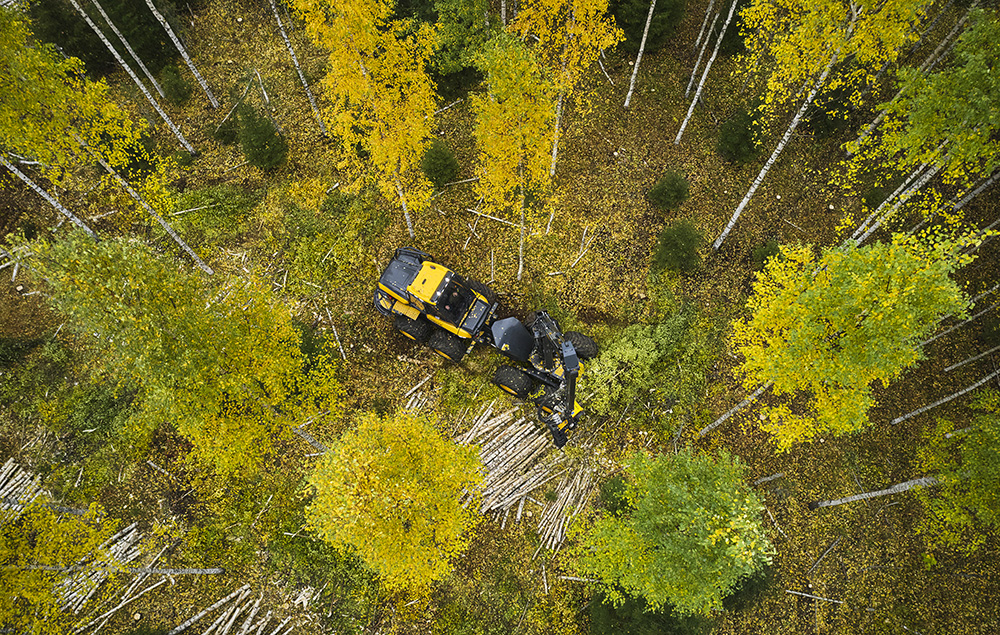
PONSSE forest machines are based on cut-to-length (CTL) harvesting. Regeneration methods and obligations in commercial forests, harvesting technologies and forest management methods play an important role when forest resources are required for carbon sequestration and as raw materials, not forgetting biodiversity in forests. In the CTL method, trees are processed in the forest according to their intended end use, allowing different parts of the stem to be utilised in the most efficient way. Accurate measurement of stem dimensions and timber volume enables the optimisation of wood raw material use and helps minimise waste.
Supports all harvesting methods
CTL machines support all harvesting methods from first thinning to continuous cover forestry and regeneration felling. For all harvesting methods, we make sure that the forest can regenerate quickly and reliably – as only the healthy growth of the next tree generation enables the continuation of the forest cycle and the regeneration of the raw material. To enable different harvesting methods, our machines must be balanced and strong, allowing for the long crane reach required at thinning sites.
The aim of CTL harvesting is to minimise machine trails. Ground pressure is reduced with eight-wheeled PONSSE forest machines, even weight distribution, and the use of wider tyres and tracks. Forwarders have the greatest impact on trails because they drive over the same path multiple times. CTL harvesters typically leave branches and crowns on the trail to protect the soil from forwarders.